


Animal protein production – meat, eggs, and dairy – is a major source of greenhouse gas emissions.
Animal protein production – meat, eggs, and dairy – is a major source of greenhouse gas emissions. As sustainability becomes a key priority, consumer awareness and regulatory pressure are reshaping the agricultural industry. Even as early as 2009, 72% of European consumers supported mandatory carbon footprint labels on food packaging. While sustainability efforts in the agricultural industry are advancing, feed production remains a major contributor to emissions. In swine production alone, it accounts for 46.5% of the total carbon footprint (Yang et al., 2023). This impact largely stems from key ingredients like cereals, oils, and premixes, which vary in their environmental footprint.
The industry is actively addressing this challenge, for example with initiatives like the Code for Green Labelling for Feed. One often-overlooked solution is the use of feed additives, included in small amounts yet capable of delivering significant sustainability gains. When formulated strategically, these additives can reduce emissions, improve resource utilisation efficiency, and enhance overall environmental performance.
SMALL INCLUSION, LARGE CONTRIBUTION
Feed additives are “products used in animal nutrition for purposes of improving the quality of feed and the quality of food from animal origin, or to improve the animals’ performance and health, e.g. providing enhanced digestibility of the feed materials” (European Commission). Unlike classical feed ingredients such as cereals, feed additives are incorporated at very low inclusion levels (generally less than 1%). As a result, the role of feed additives in improving sustainability is often overlooked and multiple studies confirm their importance.
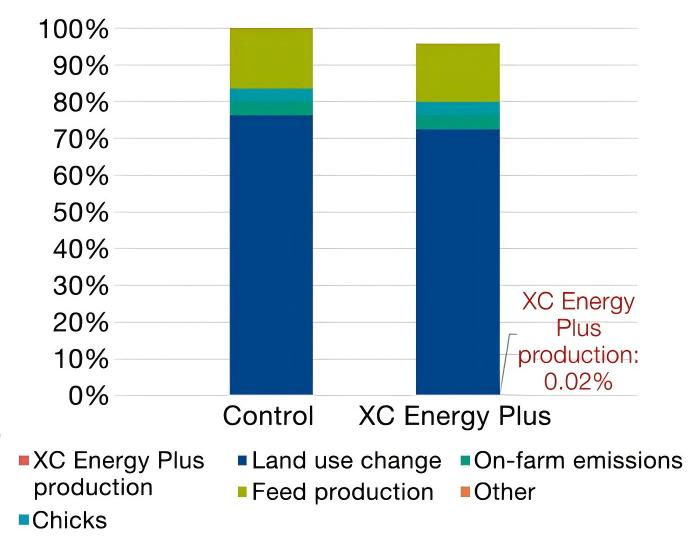
Figure 1. Carbon footprint per kg of broiler live weight, with or without Excential Energy Plus
The influence of feed additives on the environmental impact of animal nutrition can be assessed with a life cycle assessment (LCA). LCA is a “pivotal method for evaluating the environmental impacts of a product, process, or service across its entire life cycle” (PRé Sustainability BV). Orffa Additives BV has completed LCAs for several of its feed solution products with expert, independent consultants. These assessments evaluate the impact of feed additives from cradle-to-farm gate, measuring their contribution to the total carbon footprint per kilogram of animal live weight. For example, the carbon footprint of Excential Energy Plus, a digestibility promoter enhancing feed efficiency, was found to contribute only 0.02% of the total carbon footprint of the poultry feed. In broiler production, the inclusion of 0.035% of Excential Energy Plus reduced the carbon footprint of meat production by 4.22% and contributed only 0.02% to the carbon balance (Figure 1). Similar results have been observed in swine and turkey production (a 3.27% reduction in fattening pigs with a contribution of 0.05%).
The reduction in the carbon footprint of animal production when supplementing Excential Energy Plus is due to its impact on feed formulation and animal performance. By improving the digestibility of nutrients (fat, protein, and fiber), this feed additive reduces dietary energy by decreasing the incorporation of vegetable oils and animal fats. For example, soybean oil cultivated in Brazil has a high carbon footprint due to its impact on land use change (94% of the total carbon footprint). From a recent meta-analysis, it was shown that the inclusion of Excential Energy Plus can reduce metabolizable energy by 79.4 kcal/kg, resulting in a 1.5% reduction of dietary crude fat (in the form of soybean oil, for example). Additionally, feed additives that improve the feed conversion ratio may enhance sustainability, resulting in less feed consumed and a lower impact from crop cultivation. Similar meta-analyses have shown improved feed efficiency by 4% in broilers and 5% in growing-fattening pigs with Excential Energy Plus.